
Electric Dirt Bike Laws for Kids: What Parents Must Check Before Riding


Before choosing a kids dirt bike, record the rider, vehicle, and destination, then confirm access, youth rules, coverage, and fit with relevant authorities.
Before buying a kids dirt bike, note the relevant details about the child, bike, and destination. Then ask the state agency and site manager how that vehicle is classified and whether the location allows it. Proceed only after confirming access, age, supervision, equipment, documentation, insurance, and rider fit. If an authority offers a lawful alternative, adjust the plan. If any required answer remains unknown, do not ride.

Decide Whether to Proceed, Modify the Plan, or Stop
Proceed only when the exact vehicle, child, and destination meet the applicable rules and the child can control the bike within the manufacturer's stated limits. Treat any unanswered question about access, classification, supervision, equipment, paperwork, coverage, or fit as a reason to stop.
Use this parent checklist before buying or transporting a kids dirt bike:
- Record the ride details. Write down the child's age, experience, approximate height and fit, adult supervisor, exact make and model, key specifications, intended use, and destination.
- Confirm classification and access. Ask the relevant agency how the exact vehicle is classified. Then ask the property owner, park, trail operator, or land manager whether that class is allowed there.
- Confirm youth and equipment rules. Ask about age, direct supervision, helmet standard and fit, eye protection, and any other equipment required for that vehicle and location.
- Verify documentation. Check registration, identification, permits, route designation, and safety-course or training requirements separately.
- Check insurance. Ask the authority whether proof of insurance is required. Then ask the insurer whether the exact child, vehicle, location, and off-road use are covered or excluded.
- Check readiness and fit. The child must understand the controls, stop reliably, follow boundaries, respond to the supervising adult, and fit the bike and protective equipment.
- Choose the outcome. Proceed when every required condition is confirmed. Modify the plan only through an authority-confirmed lawful alternative, such as a different designated location or a completed documentation process. Do not ride when a required condition remains unresolved.
Build the ride profile next. It gives each authority the same facts instead of a vague question such as "Are electric dirt bikes legal for kids?"
Write Down the Ride Profile Before You Check the Law
Before asking whether a ride is allowed, collect enough detail for an agency or site manager to evaluate the actual child, machine, and destination. The words "electric," "kids," "teen," "off-road," and "street kit" are descriptions, not proof of legal classification or access.
Record these fields:
- Rider: age, approximate height, experience, ability to reach and operate the controls, and the adult supervision plan.
- Vehicle: manufacturer, exact model, motor output, top-speed specification, seat height, maximum load, controls, identification information, and the manufacturer's stated intended use.
- Setting: private property, public road, public trail, OHV area, park, federal forest, or other public land.
- Authority: state, county, municipality, park, trail operator, federal land manager, or property owner controlling the destination.
- Purpose: casual practice, trail riding, racing, transport, or another activity, plus the planned route and date.
A high-power, foot-peg electric dirt bike may be treated as an OHV, electric motorcycle, or another motorized vehicle rather than an e-bike. Utah's state guidance explains why actual design and intended use determine classification, including factors such as operable cranks, power, speed, and how and where the vehicle is used. Use that example as a reason to ask your own state agency, not as a nationwide rule: actual design and intended use determine classification.
If the terminology is unfamiliar, street-legal rules can provide background on registration, identification, and off-road access. They do not replace a current answer for your state, vehicle, or destination.
California provides another state-specific example. Its electric OHV guidance treats qualifying electric off-highway motorcycles as OHVs rather than electric bicycles and limits their operation under the cited rules to designated OHV areas or private property. That does not determine how another state will classify your bike. It does show why electric power alone does not establish public-road, bike-path, or general-trail access.
Use the completed profile in every inquiry. Include the exact destination and save the agency page, map, permit instructions, or written response you relied on.
Verify the Rules With the State Agency and Site Manager
The state agency answers questions about classification and statewide requirements; the destination manager answers questions about route access and site conditions. Public-land access is designation-specific, so consult OHV-designated routes and current land-manager maps before transporting the bike.
Follow this sequence:
- Identify both authorities. Name the state agency and the county, municipality, park, trail operator, federal forest, or other land manager. Permission to use private property is not automatically a universal exemption from state, local, equipment, safety, or insurance conditions.
- Send the ride profile. Provide the rider's age and fit, exact make and model, specifications, intended use, supervision plan, and destination. Ask the authority to evaluate that specific combination.
- Confirm vehicle classification. Ask whether the bike is treated as an OHV, motorcycle, electric off-highway motorcycle, or another class for the intended location. Use the vehicle class rather than the product's marketing language in the inquiry.
- Confirm destination access. Ask whether the exact class is allowed on the planned route, trail, park, or property and whether the route is currently open. Treat registration, permits, and route access as separate questions.
- Ask about youth conditions. Confirm the minimum age, whether the child must reach every necessary control, whether direct adult supervision is required, and whether a safety course or certificate applies. Utah's OHV FAQ is one concrete example of why parents should ask about a youth safety certificate and direct supervision, rather than assume one national age rule.
- Verify equipment requirements. Ask about helmet type and standard, fastening, eye protection, lighting, identification, and any location-specific equipment. State or local requirements may differ, so do not treat a bicycle helmet as universally legal for an electric dirt bike.
- Check paperwork separately. Ask whether the vehicle needs registration, an OHV decal, a permit, identification, a nonresident document, or training before the planned ride. Then ask whether those documents apply to the exact vehicle class and destination.
- Ask about local additions. A state-level answer may not cover county or municipal conditions. Colorado materials note that local governments may add conditions involving liability insurance, licenses, eye protection, or helmets for younger riders, so ask whether local rules may add insurance or equipment conditions.
- Separate insurance requirements from coverage. Ask the authority whether proof of insurance is required. Then ask the insurer, in writing, whether the exact electric dirt bike, child, location, and off-road use are covered or excluded. Motorcycle policies vary, so use policy-specific motorcycle coverage and exclusions as a prompt for questions, not as a coverage determination.
- Save the answer. Keep the current rule, route map, contact response, permit instructions, and date checked. If the agency or site manager cannot resolve a required condition, pause the ride rather than treating silence as permission.
The destination's answer controls the plan. A bike that can be registered may still be barred from a particular trail, and a location that permits OHVs may restrict the specific vehicle class or impose youth conditions.
Check Child Readiness, Helmet Rules, and Product Fit
Legal permission and child readiness are separate decisions. After the ride appears legally possible, check the equipment required by the applicable authority, then assess whether the child can safely control the bike under the planned supervision and conditions.
Which Helmet and Gear Are Required for a Kids Dirt Bike?
Ask the state agency and site manager to identify the required helmet type, safety standard, fit, fastening, eye protection, and other equipment for the exact vehicle and location. As one Utah example, the OHV safety brochure describes a properly fitted and fastened motor-vehicle helmet; use your own authority's rule rather than treating that example as universal.
Separate legal requirements from prudent protection. For a child, parents may also choose fit-appropriate eye protection where appropriate, gloves, long sleeves or a jacket, long pants, over-the-ankle footwear, and impact protection suited to the activity. Inspect every item before riding and replace gear that no longer fits or is damaged. Describe these as responsible preparation unless the applicable authority makes them mandatory.
Is the Child Ready and Properly Supervised?
The child should understand the controls, stop reliably, follow the agreed boundary, respond to an adult signal, and remain within the bike's stated operating limits. Set the supervision position, communication method, riding boundary, weather and surface limits, and stop conditions before starting. If the child cannot demonstrate these basics in the planned setting, do not proceed.
Manufacturer fit guidance is separate from a legal age rule. Meeting an age requirement does not prove that a child fits or can control a particular bike. Compare reach, seat height, load limit, controls, and the child's demonstrated ability rather than relying on the phrase "for kids" or "for teens."
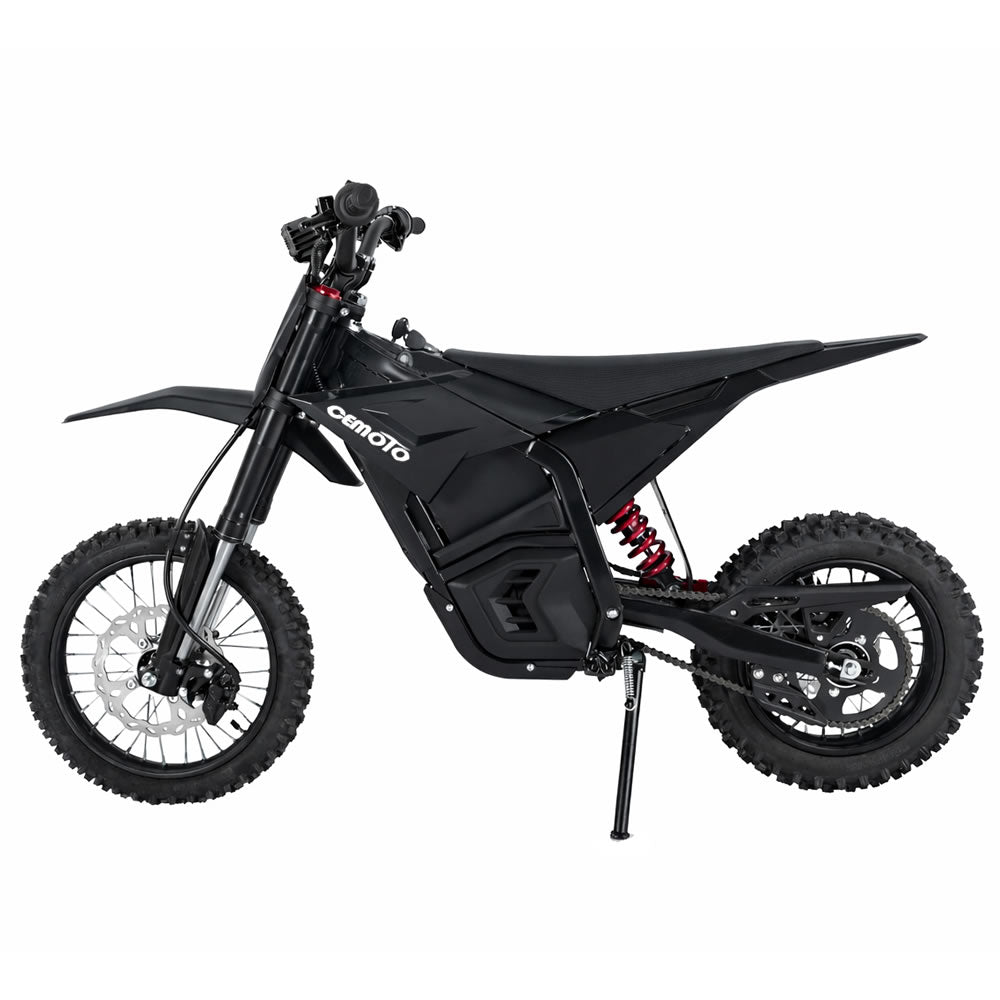
Only after the compliance decision is to proceed should you compare a potential product with the confirmed lawful use case. The CEMOTO D-Series specifications are manufacturer-provided facts for models described for teens and adults and off-road use on private land or a track. The range includes 3,000W and 6,000W peak-power models, with listed seat heights of 28.3 inches for the D02 Classic and D03 Pro and 31.9 inches for the D03 Beast. Listed top speeds are 40 mph for the D02 Classic and D03 Pro and 53 mph for the D03 Beast. Those specifications do not establish that the D-Series is a kids model, fits a particular child, is lawful at a destination, or is covered by insurance.

Use the supplied D-Series rider-height range as a general series specification, then compare it separately with the exact model's seat height, maximum load, controls, speed, and stated off-road setting. Stop if the child cannot control it, protective equipment does not fit, conditions exceed the stated limits, or a legal or coverage answer remains unresolved.
FAQs: Electric Dirt Bike Laws for Kids
These questions cover access, age, paperwork, equipment, and coverage. Use the answer that matches your unresolved issue, then take the stated next action.
Can Kids Ride Electric Dirt Bikes on Public Land or Public Trails?
Not based on a product label alone. A route may have a designation or class restriction even when another OHV is allowed. Compare the exact vehicle class with the current route rules before planning transport.
How Old Does a Child Have to Be to Ride an Electric Dirt Bike?
There is no single nationwide answer for every electric dirt bike and location. An age rule may be only one condition alongside supervision, training, fit, and vehicle classification. Compare the applicable agency rule with the child's reach and control before allowing the ride.
Do Youth Electric Dirt Bikes Need Registration, an OHV Permit, or Training?
Registration, permits, and training are separate questions, and completing one requirement does not establish that the others are unnecessary. Match each document or course requirement to the exact vehicle class and destination.
What Helmet and Safety Gear Does a Child Need for an Electric Dirt Bike?
Use the standard named by the governing rule for the exact ride. If the authority has not specified a standard, describe a properly fitted motor-vehicle helmet and other protective gear as prudent preparation rather than a universal legal conclusion.
Does a Parent Need Insurance for a Child's Electric Dirt Bike?
The authority's proof-of-insurance requirement and the insurer's coverage decision are separate. Ask the insurer in writing about the exact vehicle, child, location, and off-road use, including any exclusions, before relying on the policy.
Send the completed ride profile to the state agency and destination manager, and keep the current response with your route records. Buy or transport the bike only after you have a clear answer to proceed.
